Search this blog

Pages

Monday, December 22, 2025

The Fulfillment of the Law


                             “…love is the fulfillment of the Law.”
                             --Romans 13: 8 -10


Why is the world so angry these days? Why is America so angry? Why are Christians so angry? And why are we all so reflexively defensive? It seems to me that part of the problem is we have forgotten how to love, and forgotten what love looks like, how love acts, and what love costs. A man gets shot and instead of coming together in sorrow and compassion as a nation we start pointing fingers, Democrats desperate to blame Republicans and Conservatives righteously blaming Liberals! Each side bitterly blaming the other. A husband and wife are brutally murdered (possibly by their own son) and our president posts cruel self-righteous messages about how the victim brought it on himself. After a school shooting, instead of coming together in solidarity to protect our children each side reaches for a camera to start broadcasting vitriole and reasons why the other side is responsible for another unimaginable nighmare, another empty seat around some poor family's table. Why is it that we aren't coming together? Why are we treating each other this way? What has happened to us as a nation? As a society? As a people? It's like we are just looking for enemies? Why aren't we treating each other with love?
Perhaps we just need someone to remind us what that is... and what it looks like.

Here at Christmas time we often get quite caught up in the whole sentimental baby in the manger with lovely clean sheep hovering about, breathing their sweet warm grassy breath over the rosy cheeked, pink and freshly swaddled infant. This image of Christmas with its gentleness and radiant beauty can distract us from the truth—Love is hard. It requires sacrifice. It demands patience. And it can be exhausting…and risky. When we are expecting something tender and sentimental, we may be utterly shocked by the truth-- the wood of that manger inevitably leads to the wood of the cross. It’s unavoidable. Love makes us vulnerable, and that is very uncomfortable. Something we (by instinct) avoid at any cost. And yet, here at Christmas that is exactly the image of Christ we are presented with. A newborn child, helpless; the God who is Love lying in a manger, dependent for food and warmth upon His own creation, the comfort of His mother's breast and the warmth of her flesh holding Him close. The rough fingers of his carpenter "father" gently lifting him to change a diaper or at least the straw that makes up His bed.

Love makes us vulnerable, and that is always uncomfortable. And Love maes demands upon us, demands we too often might rather avoid.

But, as Paul reminds us in his letter to the Romans, “love is the fulfillment of the Law.” The Law is capitalized here because it refers not just to human laws but to the Law of God (as found in the Torah). Think about that; Paul is telling us that all those rules found in Exodus, Leviticus, Numbers and Deuteronomy—all those hard and fast regulations—boil down to one thing: Love.

Paul gives us three wonderful lessons at the end of Romans that—if we take them seriously—will utterly change the way we treat each other. Especially anyone we might be tempted to call our enemy. First:


                             “Vengeance is mine, I will repay, thus sayeth the Lord.” (12:19)

This tells us that getting revenge (or getting even) is not our business; that belongs to God.

Second:

                            “If your enemy is hungry, give him something to eat;
                             if thirsty, give him something to drink.
                            By doing this, you will heap red-hot coals on his head.” (12:20)


Hence, if we begin to think of someone as our enemy, we now know how God wants us to treat them: with generosity and compassion. This is what Love looks like... The answer isn't revenge, the answer isn't cruelty or meanness, but generosity and compassion. Of course, we might think this is just the old "Kill them with kindness" ploy, but is there something more to it? Is the strangeness of this lesson not just about how we treat our "enemies" but how we transform them (and ourselves)... By heaping red-hot coals of generosity and kindness upon them, we might change their hearts... But, more importantly we might change our own. It is hard to hate someone you are caring for, harder even to see them as an enemy when you see their hunger and thirst and their need for help, for compassion, for Love. It seems that the Law of God is asking us not to harden our hearts against our enemy but to become even more like Christ as we approach them. To see them not with the eyes of politics or nationality but with the eyes of Jesus.

Which leads me back to this:


                             “…love [truly] is the fulfillment of the Law…” (cf.13:8-10)

Why do Christians so quickly forget these essentials? Especially in a time of conflict? Whether it is personal or social or even international, what is it about these simple lessons that eludes us? Why does their obvious meaning fade so quickly when our eyes are clouded by anger and resentment?

Let us ponder this as we approach the celebration of the birth of God’s Love made flesh. This whole turn the other cheek, feed the hungry, care for the sick, visit the prisoners, clothe the naked, care for the vulnerable and the outcast thing isn’t just some liberal agenda run amuck. It is the fulfillment of the Law of God. And it is our call as Christians, as the Body of Christ we are called to live it, to embody it, to love our enemy and bless those who curse us, to give ourselves away, and by so doing to give our flesh to the Love of God. To let God’s love shine through our words and actions we must abe willing to allo the wood of the cradle to reveal the wood of the Cross. This way of life, this way of Love –it is the salt we are called to be for the earth; it is the Light our faith must shine in a world frightened and lost in the darkness of hate.

It is the Law and the Law is Love. What kind of blessing will you become this Christmas? And who will you bless? If you are still looking for a way to shake up your holiday season, let that become your Advent prayer.

Saturday, September 27, 2025

A great and fixed gulf: Lazarus and the rich man (Luke 16:19-31)--thoughts for the 26th Sunday of Ordinary Time

A great and fixed gulf: Lazarus and the rich man (Luke 16:19-31)


“But that is not all: between us and you

a great gulf has been fixed, to prevent those

who want to cross from our side to yours

or from yours to ours.” –Luke 16:26


That fixed gulf has been bothering me. It sounds slightly harsh, and even hard-hearted on the surface. And that feels like a kind of stumbling block messing with my idea of God’s love. Of course, having my ideas and notions challenged is almost always a good thing. Like most people, I too easily get set in my own patterns and habits of thinking. And it is good for me to be reminded that my ideas are not God’s. But, it is a particularly painful stumbling block just now because this week I have been listening to a few voices talk of “tough love.” And on the surface, a teaching like this might seem to be an affirmation of such talk. Tough love sometimes has to set boundaries, create barriers, even fix a great gulf between people, even people who want to help.  And yet, the tough love talk I heard seemed to have much more emphasis on the tough than on the love. And the voices seemed to only grow harder the longer they talked, opinions and ideas becoming fixed... The life-giving warmth of love fading into something cold and lifeless. So I am struggling with the idea of tough love, and with this vision of a gulf that seems intended to prevent the flow of mercy or compassion, and with the idea that this gulf was “fixed” (or created) by a loving God.

Ok; so, start there. (And yes—I understand this is a parable, and I may be over-thinking things. Again, let that be part of the very premise I am about to present.)

Now, with that groundwork in place, let me for a moment ponder some ideas about that “great gulf.” My initial concern is: why? Why would a loving, merciful, life-giving God (who—in fact-- is Love) “fix” a gulf between the saved and the lost to prevent souls from crossing? What would He be preventing? Repentance? Access to His grace? To His Mercy? His love? Why?

Of course, some might answer because real love is “tough,” and choices have consequences, therefore some souls may find themselves hopelessly suffering in Hell, because they deserve it. It’s natural consequences.  Divine justice. That reading turns this great fixed gulf into an element of God’s justice. Seen through the lens of “tough love” this fixed gulf is an actual barrier –like a vast chasm between two spaces, something like the afterlife’s version of the Grand Canyon—a truly uncrossable space—even for a Heavenly Evil Knievel. And yes, that feels like tough love. But, to my ear it doesn’t actually sound like God’s love.

And so, I turn back to the parable itself, wondering if there might be a clue about that gulf and how and by who it was fixed. A truth that might reveal something about the toughness of God’s love.

“There was a rich man who used to dress in purple
and fine linen and feast magnificently every day.
And at his gate there used to lie a poor man called
Lazarus, covered with sores, who longed to fill
himself with what fell from the rich man’s table.
Dogs even used to come and lick his sores…”
Luke 16: 19-21


Do you notice another gulf in this story? The gulf between the rich man’s table and his gate? The gulf between the rich man’s feasts and Lazarus’s hunger? The gulf between his fine linen and purple garments and Lazarus covered with sores that are licked by the dogs. And what about those dogs? Are they there at the rich man’s gate to drive away poor ragged beggars? Or were they wild strays that also hungered for scraps, and licking the wounds of Lazarus was somehow a comfort to them and perhaps even him?

Ah, but I must let those dogs run free for now, and return to that fixed gulf. As I read this parable, that gulf isn’t fixed by God—but by the rich man. And it isn’t waiting for him somewhere in eternity, it is forming inside of him every time he feasts, and every time he turns away from the needs of the beggar who waits at his gate. It isn’t a sign of God’s judgment, but of the choices, the blindness and the selfishness that have shaped his life. It is a habit of the soul and is fixed by choice, not by God. The rich man lived a life of chasms and barriers, a life of self-protection, and self-defense one might say, protecting his own comfort and defending his own security with wealth and gates and dogs (maybe) and protecting himself from discomfort and vulnerability by carefully managing his finances and willfully turning away and ignoring others—especially those unpleasantly in need. This fixed gulf is not an imposed barrier or punishment from a righteously indignant God, but a sign of a Loving God’s willingness to allow His creation the freedom to be who and what we choose to be. Even if that means we make a private Hell from our own choices.

And this reading—again, let me remind you (and myself ) that my understanding could be clouded by my own willfulness or prejudices, focused through the lens of my own theological preferences, BUT… there are two things about God that seem pretty clear to me: 1st, that the Love of God excludes no one, and 2nd that the way we receive that Love is what determines our eternity. Are we open to it? Do we long for it? Have we nurtured within ourselves the desire to be in His presence, to enter fully into His love? To die to ourselves and say with utter certainty: Thy will be done? Or have we nurtured within ourselves a desire to become our own gods, to selfishly protect and defend our own opinions and ideas like they were sacred idols, make an altar of our own security and safety, putting always our own desires and needs on that altar, and chanting always to ourselves: My will be done?

In fact, I wonder now, isn’t it clear that—how we live shapes that gulf and fixes it in place. A tough love that excludes others, drives them away, ignores their humanity or has no patience, compassion or sympathy for frailty and weakness --that kind of love --Is it really love? Or is it actually an emptiness that creates a gulf and fixes it inside my own heart by ignoring those in need, the vulnerable, the challenging, the lost, those who are different, those who make me uncomfortable?

Or have I built a bridge across that gulf by opening my heart and life to those in need, by feeding the hungry, caring for the sick and the sorrowing, visiting the prisoners of poverty and loneliness as well as those in actual prisons?


In other words, we can hide from love behind a gulf of “toughness” or we can lay down our lives, take up the cross, and let the Love of God become a bridge between us. 


And all of this does have (for me) a very personal connection.  I had a brother who was not easy to love. He was an addict, a thief, a drunk, a man who would promise to change, but found the effort often beyond him. And there was a time when I turned away from him. Didn’t want him around my family, my children because I was afraid of what he might do or say.  He made life hard, uncomfortable. And things often got broken when he was around—vases, toys, feelings.  I was afraid of him, of what his needs might demand from me, and of losing the secure, comfortable life I was trying to build for myself.  In the end, as he was dying in utter poverty, his dog, always beside him, his only comfort… I have to wonder.  What would have happened if I had taken up his cross, instead of driving him away?  I was not a bad brother, helping him with money when needed, talking to him on the phone for hours when he would call… But I was not a brother who was willing to lay down his comfortable life for the sake of another.  My love wasn’t tough.  It was cowardly.


The memory of my brother, and my failure, has shaped my life. Every day I must ask myself: Have I fixed a gulf or become a bridge? Which kind of love sounds tougher to you? And which one sounds more like Jesus?

Take up your cross and follow Me, Jesus says.  Talk about toughness.

Friday, July 11, 2025

And who is my neighbor --Some thoughts for the 15th Sunday of Ordinary Time & the Parable of the Good Samaritan

 "But wanting to justify himself,
he said to Jesus: And who is my neighbor?"

Luke 10:25-37

The Catholic church follows a liturgical cycle of readings. What this means is that the readings at each mass are pre-determined, scheduled, following a 3-year plan. The cycle completes itself and starts over every 3 years. Years are designated A, B & C---and currently, we are in year C.  What this means in practice is that instead of a priest or liturgist selecting particular passages from scripture because they fit some pastoral concern or address a specific issue, the readings are determined by the cycle and every 3 years on the 15th Sunday of Ordinary Time, we hear the same series of readings including the story of the Good Samaritan. One of the odd blessings about such a system, is that the choice is not ours, the message is not selected by us, but imposed upon us and that imposition, if we allow it, can become a blessing of opportunity.  It calls us out of the hamster-wheel of our habits and hungers and preferences, and invites us to look at life through a different lens, see the world around us from a different point of view.


And so, in the midst of all the strange and terrible goings on in our country, a president who seems to think he is a king, a congress that acts like cartoon minions, and agents of the government running around in masks arresting nursing mothers, day-laborers, and college students, we might have wanted to hear a message about justice or about the collapse of society, about God’s wrath on corrupt leaders… But, instead this Sunday at mass we will hear the parable of the Good Samaritan, and each of us will be given the opportunity to consider: what kind of neighbor am I?  


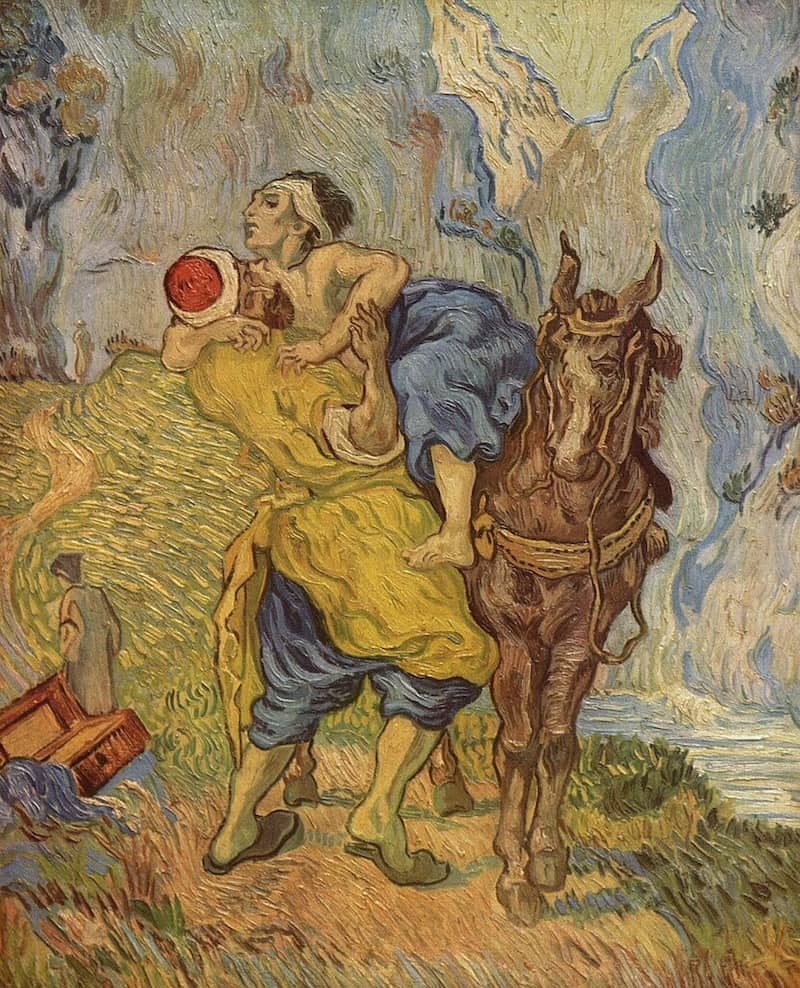
The story of the good Samaritan is probably one of the most familiar of all the parables. It is the story of a man who is beaten and robbed and left for dead on a roadside and three people who walk by his naked body.  Two of them, a priest and a lawyer, keep going. They see the man, but walk on without helping.  Only the third, a Samaritan (someone Jesus’s audience wouldn’t have wanted to associate with), stops and helps the man, caring for his wounds and taking him to safety.  Re-reading this parable I have come to wonder if it may be the most radical of all the parables.  Not only does the Samaritan stop and help the wounded man, but he takes him to an inn, watches over him, then pays the inn-keeper extra money to help.


And it all starts with a lawyer asking about the law, about the rules, asking about what is required to be a good Jew; as if he is trying to get Jesus to say: these are the minimum requirements to avoid breaking the law, to stay out of trouble with God.  The lawyer has quoted the law to Jesus, the rules: You must love God with all your heart, and love your neighbor as yourself.  And when Jesus affirms it, the lawyer, as if looking for a loophole, asks: But, who is my neighbor?


The lawyer’s simple question reverberates with the self-justifying sound of fear. Behind it one senses a fear of obligations and limitations, and the very human worry about having enough, about running out of time, energy, resources. But instead, Jesus answers with a story of generosity and compassion, discomfort and self-sacrifice.  The Samaritan is on a trip, headed somewhere, he doesn’t know the man, has no obligations toward him, and yet he alone, of the three responds with love; he alone sets his own plans and needs, perhaps his own obligations and limitations aside responds with compassion, selflessly allowing the needs of another to become an opportunity to serve.   Historically, Samaritans were seen by the Jews as outcasts or rejects; heretics and half-breeds. And yet it is the Samaritan, not the “good Jews,” the Priest and the Levite, who shows concern for the victim, who treats even a stranger with compassion, with love.


Instead of answering in legal terms, Jesus flips the question with a story about radical kindness. Shifting the focus from requirements and culpability to generosity, He asks the lawyer: Which of the three, do you think, acted like a neighbor?  He turns the focus away from othering, from borders and tribal distinctions --who is my neighbor—making it personal –what kind of neighbor am I? 


Who is my neighbor, the lawyer asks, and Jesus responds with a parable about a stranger, and radical compassion.


Jesus is challenging us to act with love not just toward family and friends, classmates or co-workers, not just the easy and the familiar, but to treat with love, with radical generosity, even when its uncomfortable, when its unplanned and disruptive to our schedule, even when it’s scary.  He calls us to see through the Law into the Love. A Love that connects, that binds us all, friend and foe, family and stranger.


And there are few stranger than our current president, and few more frightening, and possibly none who needs love more –unless, of course, we count the widows, the orphans, the homeless, the refugees, the prisoner, the naked, the hungry, the thirsting…


And yet, even as I write this, I wonder might we not find all these qualities lurking somewhere beneath the prideful and belligerent façade of this man who seems to think he is a king.  And yet, again, are we not called to love all people? Not just those who are easy to love, who make us feel comfortable, or safe. The real opportunity comes unplanned, in the uncomfortable, in the chance to give of ourselves completely, without expecting anything in return.  


And one thing this parable makes uncomfortably clear: it is impossible to love someone if we are too busy “othering” them. Whether it is the immigrant, the refugee, the disabled, the different, or just a poor victim left wounded and naked in a ditch.


One of the blessings of having a liturgical cycle, is that readings are forced upon us; imposed, instead of proposed. And because they are, they can catch us off-guard, unprepared, surprising us with their prophetic truth and demanding that we pay attention.   In a sense, they come as unexpected as an encounter with a stranger in need. Whether it’s comfortable or not, we are called to listen, to engage, and if we are willing—to respond, to be changed, to let the words challenge and change us.  


Perhaps this moment in American history is a similar kind of challenge. We can debate the president’s policies and behavior all we want, but we must realize—he is ours, we elected him, and in some very frightful way—he is us! He is a challenge to be met, and we can either keep walking, pretending we don’t see, or we can stop and say: this cannot be. I must do something.


Is this not a time when we musts stop looking at borders and races, memberships and “tribes,” and instead open our eyes to the humanity of all people, look upon even those who don’t look like us, act like us, think like us, not as a problem to be avoided or cast out, but as an opportunity to encounter and become. Instead of asking: Who is my neighbor? we must ask: Who is in need? And what can I do to help?  In this unexpected and unplanned moment, we find not just a challenge or a duty or an obligation, but an opportunity to become the people we all want to be, the person who walks toward the cross, the neighbor who—in our hour of need—we all hope to see.

The Good Samaritan, 1890 by Vincent van Gogh